

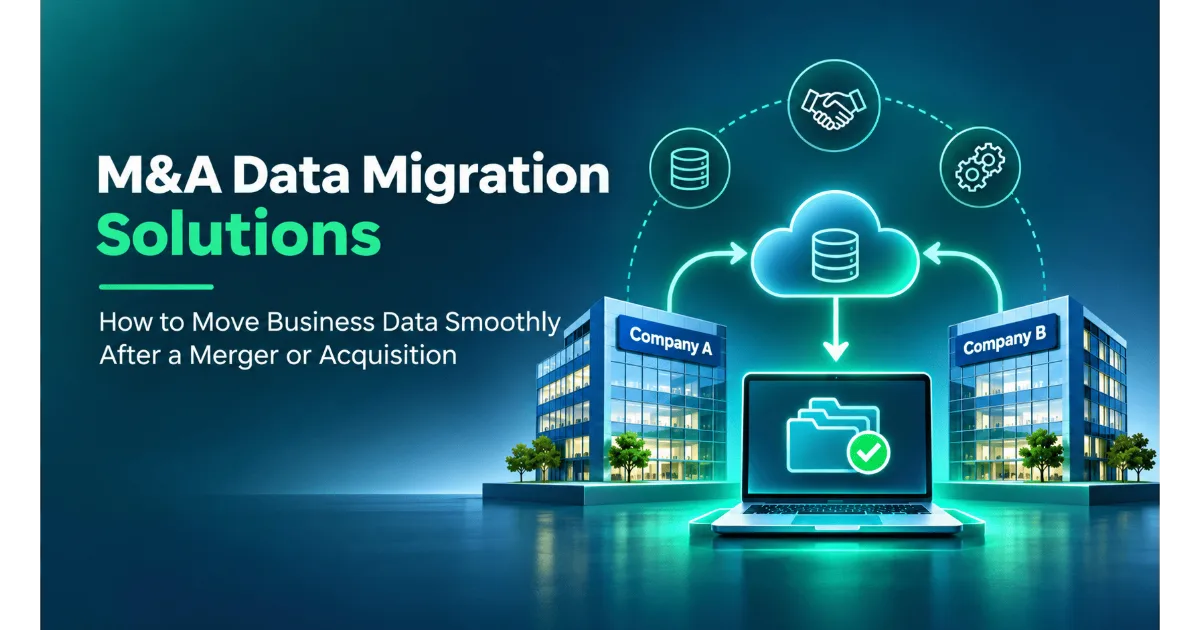
Mergers and acquisitions bring new opportunities for business growth. Companies can expand their operations, enter new markets, acquire new customers, and bring teams together. However, combining two businesses also comes with several challenges. One of the biggest is moving data from different systems into a single, organized environment.
After an acquisition, both companies may use different software, databases, applications, and data formats. Customer records, financial information, employee details, sales data, and operational records may be stored in separate systems. Moving all this information without losing important details can be difficult.
This is where M&A data migration solutions become important. They help businesses transfer, organize, clean, and validate data during mergers and acquisitions.
In this blog, we will explain how M&A data migration works, why businesses need it, what to look for in migration software and platforms, and how professional M&A data migration services can make the process easier.
Continue Reading
What Is M&A Data Migration?
M&A data migration is the process of moving business data from one company's systems to another company's systems during or after a merger or acquisition.
The goal is to bring information from different sources into a common environment where teams can access and use it.
For example, imagine Company A acquires Company B. Both companies have separate customer databases, accounting software, HR systems, and business applications. After the acquisition, the new organization may want to bring this information together.
This process involves:
Collecting data from different business systems.
Identifying duplicate and outdated records.
Cleaning and organizing information.
Mapping data fields between old and new systems.
Converting data into the required formats.
Moving data into the target system.
Checking data accuracy after migration.
A well-planned migration helps businesses maintain access to important information while reducing disruption to daily operations.
Why Is Data Migration Important During Mergers and Acquisitions?
Data plays an important role in almost every business activity. When two organizations come together, their information needs to work together as well.
Without a proper migration process, businesses may face problems that affect operations, reporting, customer relationships, and decision-making.
Here are some common reasons why data migration is important during M&A.
1. Bringing Business Data Together
Different companies often use different systems to manage their operations. Data migration helps bring information from these systems into a common environment.
This gives employees access to the information they need without switching between multiple disconnected platforms.
2. Reducing Duplicate and Incorrect Data
Both organizations may have records for the same customers, suppliers, employees, or business partners. Moving these records without checking them can create duplicates and confusion.
Data cleaning and validation help improve data quality before and after migration.
3. Maintaining Business Operations
A merger or acquisition should not stop normal business activities. Employees still need access to customer information, financial records, contracts, and operational data.
A planned migration helps reduce interruptions and supports business continuity.
4. Improving Reporting and Decision-Making
When business data is spread across different systems, preparing combined reports can take time.
Bringing data together makes it easier for management teams to review business performance, compare information, and make informed decisions.
5. Supporting Security and Compliance
Business data may contain sensitive customer, financial, and employee information. During migration, organizations need to maintain proper access controls and follow applicable data protection requirements.
A secure migration process helps protect information throughout the transition.
Common Challenges in M&A Data Migration
Although data migration sounds straightforward, combining information from two organizations can be complicated. Some common challenges include:
Different Data Formats and Systems
One company may use Salesforce, while another may use a different CRM. Their databases may also have different structures, field names, and formats.
This makes it difficult to move information directly from one system to another.
Duplicate Records
The same customer or supplier may exist in both companies' databases. Without proper matching and deduplication, the new system may contain multiple records for the same entity.
Poor Data Quality
Old records may contain missing fields, incorrect values, outdated contact details, or inconsistent formats. Moving this information without cleaning it can create problems in the new system.
Complex Data Relationships
Business data is often connected. A customer record may be linked to orders, invoices, support tickets, and contracts.
If these relationships are not maintained during migration, important business information may become disconnected.
Limited Time and Resources
M&A projects often have tight timelines. IT teams must manage data migration along with system integration, business operations, and other transition activities.
Manual processes can make the work slower and harder to manage.
What Are M&A Data Migration Solutions?
M&A data migration solutions are tools, technologies, and processes that help organizations move and integrate data during mergers and acquisitions.
They support different stages of migration, from extracting information from existing systems to validating it in the target environment.
A good solution should help businesses:
Connect with multiple data sources.
Extract information from different systems.
Clean and standardize records.
Map fields between source and target systems.
Transform data into the required structure.
Identify duplicate or incomplete records.
Validate migrated information.
Track migration progress and errors.
The right solution depends on the size of the acquisition, the number of systems involved, data complexity, security requirements, and business timelines.
M&A Data Migration Software: What Should Businesses Look For?
M&A data migration software helps automate important parts of the migration process. Instead of relying completely on manual work, teams can use software to extract, map, transform, and validate data.
However, not every migration tool is suitable for a complex M&A project.
Before selecting software, businesses should consider the following features.
1. Multiple Data Source Support
The software should support different databases, applications, files, and business systems. This is important when the two organizations use different technology environments.
2. Automated Data Mapping
Data mapping connects fields from the source system to the correct fields in the target system.
For example, one system may use the field name "Customer Name", while another uses "Account Name". The software should help teams identify and map these fields correctly.
3. Data Cleaning and Standardization
The software should help identify missing values, duplicate records, incorrect formats, and inconsistent information.
This makes it easier to prepare data before moving it into the new environment.
4. Data Transformation
Sometimes, information needs to be changed before it can be used in the target system. Data transformation helps convert values and structures into the required format.
5. Validation and Error Tracking
Migration does not end after data is transferred. Teams need to check whether records have been moved correctly.
Validation features help identify missing information, incorrect mappings, and failed records.
6. Security and Access Control
M&A projects involve sensitive business information. Software should support appropriate security measures, access management, and auditability.
7. Scalability
The software should be able to handle the volume and complexity of data involved in the project. It should also support future migration requirements as the business grows.
M&A Data Migration Platform: How Does It Help?
An M&A data migration platform provides a structured environment for managing different stages of data migration.
While individual tools may handle specific tasks, a platform can bring multiple migration activities together in one workflow.
For example, an organization may need to migrate customer data, employee records, financial information, and operational records from several systems.
A centralized platform can help teams manage these activities through a connected process.
Some important benefits include:
Centralized migration management: Manage different migration activities from one place.
Better visibility: Track migration progress and identify issues.
Consistent data handling: Apply common data rules across different sources.
Reduced manual work: Automate repetitive migration tasks.
Improved data quality: Clean and validate records before using them.
Better collaboration: Help business and technical teams work together during migration.
The main advantage of a platform is that it can make a complex migration project easier to manage, monitor, and control.
M&A Data Migration Services: When Should You Consider Them?
Not every organization has the internal resources or technical experience to manage a large-scale migration project.
In such cases, M&A data migration services can help businesses plan and execute the process with support from experienced specialists.
These services may cover the complete migration lifecycle.
1. Data Assessment
The migration team reviews existing systems, databases, data formats, and business requirements. This helps identify the scope of work and possible risks.
2. Migration Planning
A migration plan defines which data needs to be moved, where it will go, how it will be transformed, and when each activity will take place.
3. Data Extraction
Data is collected from the source systems, databases, applications, and files.
4. Data Cleaning and Mapping
The extracted information is checked for duplicates, missing values, and inconsistencies. Source fields are then mapped to the appropriate target fields.
5. Data Transformation and Migration
The data is converted into the required format and transferred to the target environment.
6. Testing and Validation
The migrated information is checked to confirm that records, values, and relationships have been transferred correctly.
7. Post-Migration Support
After migration, teams may need help resolving errors, checking system performance, and addressing issues reported by users.
Professional services can be useful when a project involves multiple systems, large datasets, complex data relationships, or strict timelines.
How to Choose the Right M&A Data Migration Solution
Choosing the right solution is an important decision. A tool that works well for a small database transfer may not be suitable for a large acquisition involving multiple business applications.
Here are some points to consider before making a decision.
- System Compatibility: Can it connect to your existing and target systems?
- Data Mapping: Does it support automated and custom mapping?
- Data Quality: Can it identify duplicates, missing values, and incorrect records?
- Transformation: Can it handle different data formats and structures?
- Validation: Does it provide checks to verify migrated data?
- Security: Does it support access controls and secure data handling?
- Scalability: Can it handle large and complex migration projects?
- Reporting: Can teams track progress, errors, and migration results?
- Support: Is technical assistance available when required?
Businesses should also consider the complexity of their data, the migration timeline, and the level of customization needed.
The best option is not always the one with the most features. It is the one that matches the organization's actual migration requirements.
How AI Is Changing M&A Data Migration
Artificial intelligence is making data migration more efficient by helping teams handle repetitive and time-consuming tasks.
AI-powered migration solutions can support activities such as data classification, field matching, duplicate identification, and data quality checks.
For example, when two companies use different field names for similar information, AI can help suggest possible matches. Teams can review these suggestions and approve the correct mappings.
AI can also support:
Identifying patterns in large datasets.
Finding duplicate or inconsistent records.
Suggesting data mappings.
Highlighting missing information.
Supporting data quality checks.
Reducing repetitive manual work.
However, AI should not replace human review completely. Business-critical data, sensitive information, and complex migration decisions still need proper validation and approval.
A combination of AI automation and human oversight can help businesses manage migration more effectively.
How Quarks Technosoft Helps with M&A Data Migration
Quarks Technosoft offers MergeBridge, an AI-powered solution designed to support post-acquisition data migration.
When two companies come together, their data may be spread across different systems, formats, and databases. MergeBridge helps address this challenge through an organized migration workflow.
It supports key migration activities, including:
Data Extraction: Collect information from different source systems.
Data Cleansing: Identify and address duplicate, incomplete, and inconsistent records.
Data Mapping: Map source fields to the required target structure.
Data Transformation: Convert information into the format needed by the target environment.
Data Validation: Check migrated information for accuracy and consistency.
Common Data Model: Help bring information into a common structure.
Human-in-the-Loop: Keep people involved in reviewing important migration decisions.
Audit Trail: Maintain visibility into migration activities and changes.
By bringing these activities into a connected workflow, MergeBridge helps organizations manage the challenges of combining data after an acquisition.
For businesses planning a merger or acquisition, having a structured migration process can make the transition easier to manage.
Learn more about MergeBridge by Quarks Technosoft.
Final Thoughts
Data migration is one of the most important parts of a successful merger or acquisition. When two organizations use different systems, bringing their information together requires proper planning, data mapping, transformation, and validation.
The right M&A data migration solutions can help reduce manual work, improve data quality, and make it easier to bring business information into a common environment.
Whether a business chooses M&A data migration software, an integrated M&A data migration platform, or professional M&A data migration services, the focus should remain on accuracy, security, and business continuity.
With AI-powered solutions such as MergeBridge, organizations can also use automation and human review to manage complex post-acquisition data migration requirements more effectively.
Frequently Asked Questions
1. What are M&A data migration solutions?
M&A data migration solutions are tools and processes that help businesses move, clean, map, transform, and validate data when two organizations merge or one company acquires another.
2. What is M&A data migration software?
M&A data migration software helps automate tasks such as data extraction, mapping, transformation, cleansing, and validation during mergers and acquisitions.
3. How is an M&A data migration platform different from migration software?
Migration software may focus on specific tasks, while an M&A data migration platform can bring multiple migration activities into one environment for centralized management and monitoring.
4. When should a company use M&A data migration services?
A company should consider professional migration services when it has multiple source systems, large datasets, complex data relationships, limited internal resources, or a tight migration timeline.
5. How does AI help in M&A data migration?
AI can help identify duplicate records, suggest field mappings, classify information, and highlight data quality issues. Human review is still important for validating critical decisions.
6. How can businesses reduce data loss during M&A migration?
Businesses can reduce the risk of data loss through proper planning, backups, data mapping, testing, validation, and post-migration checks.
7. What should businesses look for in an M&A data migration solution?
Businesses should look for system compatibility, automated mapping, data cleansing, transformation, validation, security, scalability, reporting, and technical support.



I particularly like the focus on combining AI-powered automation with human oversight. Technology can simplify complex migration tasks, but careful validation and the right strategy make all the difference.
Great insights on an important aspect of successful M&A integration! 👏